
A global Microsoft outage is delaying email responses and causing minor service disruptions. For issues, please use our Customer Support Portal.
Find out more: Global Microsoft outage: Service update

What the new Aged Care Act means for your organisation — and where we’re heading together
When aged care systems and workflows don’t connect, the gaps show up in everyday moments.
A family member explaining their loved one’s care history for the third time. A nurse documenting medication at the nurses’ station when she should be at the bedside. A facility manager pulling reports manually the night before an audit. These aren’t individual failures. They’re proof of a fragmented healthcare system.
In conversations about sustainability and reform, one term keeps coming up: workflows. And for good reason. Well-designed workflows can help reduce administrative burden, support compliance, and allow for more consistent care — without increasing workload.
From policies to demonstrated outcomes
The new Aged Care Act and Strengthened Quality Standards are shifting regulatory expectations. Providers are no longer simply asked to have policies in place — they’re expected to demonstrate that care is being delivered consistently, safely, and in line with each resident’s individual needs and rights.
That means showing:
- Clear links between assessments, care plans and what’s actually delivered
- Evidence that risks are identified, escalated and managed appropriately
- Consistency across staff, shifts and sites
- Governance visibility supported by reliable data
Manual or disconnected workflows make this difficult — not because staff aren’t diligent, but because the systems force workarounds, and every workaround is a gap in the evidence trail.
The providers managing this well have something in common: their workflows are built into daily practice, not layered on top of it.
As Katrina Crump, Clinical Practice Specialist at Uniting, notes, “Moving away from task-driven assessments and care plans helps staff see the person, not just the checklist — while still ensuring all clinical care elements are addressed.”
The difference between digitising and connecting
There’s an important distinction between digitising existing processes and redesigning them for connected care. Moving paper forms into a system is digitisation. Building workflows where clinical, medication, funding and communication data flow between the right people at the right time — that’s connection.
Bringing resident information into one unified environment supports consistent workflows across teams, reduces training overhead, strengthens data quality and helps organisations stay audit-ready — without pulling attention away from residents.
In residential aged care, workflows that genuinely support quality care tend to share a few consistent characteristics:
- Integrated by design: They connect assessments, care plans, medication, funding and communication in one place, surfacing risks before they become incidents.
- Embedded in care delivery: They capture evidence at the point of care, not retrospectively.
- Context-aware: They reflect each resident’s individual needs rather than applying one-size-fits-all processes.
- Secure and reliable: They meet Australian privacy, security and data sovereignty requirements.
- Adaptable: When regulations change, workflows adapt without disrupting the team.
When these elements are in place, compliance stops feeling like a separate workstream, and becomes a natural output of care well delivered.
How smarter workflows benefit different stakeholders
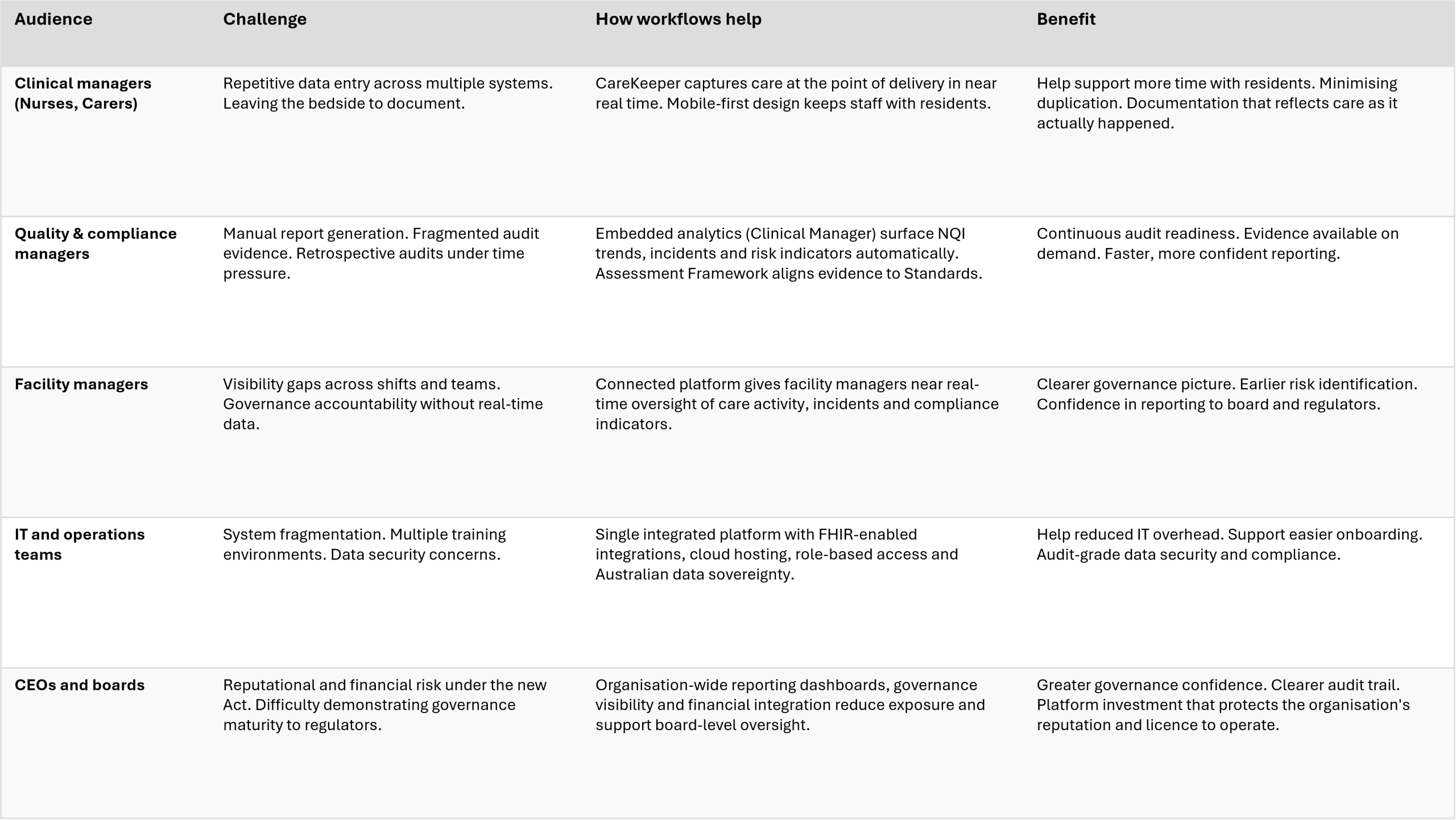
How Telstra Health supports your organisation today
Over 220 aged care organisations trust Telstra Health to support more than 80,000 beds across residential aged care settings. Our software is built to help liberate nurses and carers from routine administration, so they can spend more time supporting and caring for people.
Time-saving smart tools, AI-powered assistance and task automation power the workflows your teams rely on every day:
CareKeeper puts clinical workflows on mobile devices so staff can document at the point of care — in near real-time, even in environments with limited connectivity. Whether your facility is multi-storey, regional or high-acuity, your team can capture what matters without stepping away from the bedside.
Clinical Manager connects assessments, care plans and incident tracking in a single environment. Its built-in clinical analytics take reporting beyond retrospective, static exports — embedding visual, near real-time insights directly into the system where they can inform confident, timely decisions.
Those analytics support:
- Early identification of clinical risk
- Monitoring of trends including wounds, incidents, weight and infections
- Improved governance visibility
- Reduced reliance on manual reports
Resident Manager, Medication Management and Message Manager complete the picture — connecting the administrative, clinical and communication layers that too often sit in separate systems, creating friction for staff and gaps in the resident record.
Together, these solutions help your organisation stay audit-ready, not just audit-prepared.
Real-world impact of intelligent aged care workflows
Whiddon, an award-winning not-for-profit aged care provider, recently worked with Telstra Health to strengthen its care model and ensure its people had the tools they needed to continue delivering meaningful, relationship-based care.
“We identified the need to modernise our systems to enhance data accessibility and integration, while meeting evolving care and compliance requirements,” said Whiddon’s Chief Operating Officer, Alyson Jarrett. “To achieve a robust, reliable, and future-ready solution, we partnered with Telstra Health to support our broader transformation journey and ensure the delivery of high-quality care across our homes.”
By connecting its core clinical, medication and communication systems, Whiddon is building the foundations for a more connected, efficient and personalised aged care experience.
Building for interoperability
Reform isn’t just changing what providers need to demonstrate internally — it’s changing how care needs to flow across settings. A resident moving between a GP, a specialist and an aged care facility carries a clinical story that should travel with them. Too often, it doesn’t, because the systems that hold it don’t talk to each other.
Using FHIR® open standards, Telstra Health’s platform is designed to support secure data exchange across aged care facilities, care teams, GPs, hospitals, allied health and e-health records. The goal is connected care, wherever a person is in their health journey.
What’s coming next: Telstra Health Corus
Workflows are increasingly central to how providers deliver safe, sustainable and high-quality care. They sit at the intersection of compliance, workforce sustainability, care quality and organisational resilience — shaping not just how work gets done, but how care is experienced. The challenge for providers is no longer whether to invest in smarter workflows, but how to make sure those workflows are intelligent, integrated and able to adapt as expectations continue to evolve.
The investments you’ve made in connecting your clinical, medication and care systems are laying the groundwork for the next generation of care. Telstra Health Corus is our standards-based, cloud-native care intelligence ecosystem, designed for a world where clinical insight follows people across every care interaction, from residential aged care to primary care and beyond.
Built on open interoperability standards, Corus is designed to grow from the foundations you’ve already built with us. For existing Telstra Health customers, Corus represents the natural next chapter. For organisations exploring what more connected care could look like, learn more about Corus: telstrahealth.com/corus